 English
- English
-
 Français
 -
 日本語
日本語 -
 Deutsch
 -
 tiếng Việt
 -
 Italiano
 -
 Nederlands
 -
 ภาษาไทย
 -
 Polski
 -
 한국어
한국어 -
 Svenska
 -
 magyar
 -
 Malay
Malay -
 বাংলা ভাষার
 -
 Dansk
Dansk -
 Suomi
Suomi -
 हिन्दी
 -
 Pilipino
 -
 Türkçe
 -
 Gaeilge
 -
 العربية
 -
 Indonesia
 -
 Norsk
Norsk -
 تمل
تمل -
 český
český -
 ελληνικά
 -
 український
 -
 Javanese
 -
 فارسی
فارسی -
 தமிழ்
தமிழ் -
 తెలుగు
 -
 नेपाली
 -
 Burmese
 -
 български
 -
 ລາວ
ລາວ -
 Latine
 -
 Қазақша
 -
 Euskal
 -
 Azərbaycan
 -
 Slovenský jazyk
 -
 Македонски
 -
 Lietuvos
 -
 Eesti Keel
 -
 Română
 -
 Slovenski
 -
 मराठी
मराठी -
 Srpski језик
 -
 Español
 -
 Português


Why Does Your Workshop Need a Slant-Bed CNC Lathe for High-Stability Turning?
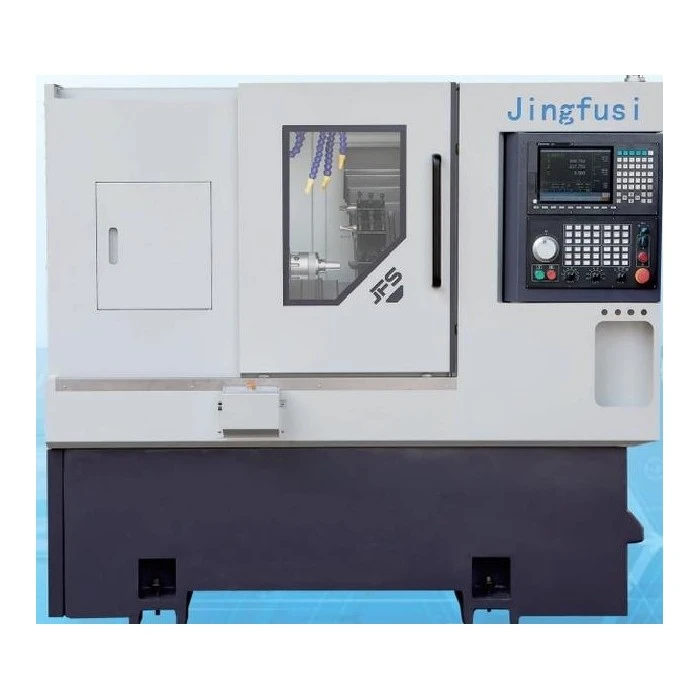
In the realm of modern precision machining, the demand for equipment that delivers both speed and surface finish has never been greater. Manufacturers seeking to produce components with mirror-like surfaces must consider the structural integrity of their machine tools. The Slant-bed CNC lathe has emerged as a solution for workshops aiming to eliminate visible tool marks and achieve specular highlights on turned products. This article explores why this configuration outperforms traditional layouts, focusing on real-world stability and quality standards, with insights from a dedicated manufacturer like Foshan Jingfusi CNC Machine Tools Company Limited.
Understanding the Rigidity Advantage of a Slant-Bed Configuration
A slant-bed design inherently provides superior chip evacuation and reduced vibration. Unlike flat-bed alternatives, the inclined structure allows gravitational assistance in removing swarf, preventing re-cutting and thermal distortion. This directly impacts surface quality, enabling the turning process to produce grain-free finishes. The unified accessory standard adopted by serious manufacturers guarantees that the machine body and turret assembly work as a single rigid unit. When evaluating a Slant-bed CNC lathe, one must inspect how the cutter holder and power head integrate onto the tool bed plate—any deviation introduces variability that degrades long-term accuracy.
Why Unified Accessories Are Non-Negotiable for Quality
Professional machine tool builders refuse to mix low-grade configurations. This policy stems from the necessity of maintaining consistent quality inspection benchmarks. Different power head or turret designs alter the dynamic response of the lathe, affecting both service life and after-sales support efficiency. For a Slant-bed CNC lathe to deliver specular lighting on turned surfaces, every component from the spindle to the tool turret must adhere to a single standard. Customization that bypasses approved accessory lists may seem attractive, but it ultimately compromises the machine's ability to achieve grain-free finishes.
Key Structural Elements That Determine Surface Quality
Surface brilliance on a turned product requires three conditions: high spindle stability, consistent tool path rigidity, and vibration-free chip flow. A slant-bed chassis satisfies these by lowering the center of gravity. Additionally, when the turret is mounted directly on the cutter bed plate without intermediary adapters, the loop stiffness increases substantially. Manufacturers that enforce strict accessory policies—such as rejecting generic power heads—ensure that each delivered lathe meets the promised specular lighting standard. Below is a comparison of typical design choices and their impact on turning results.
| Design Feature | Effect on Turning Stability | Resulting Surface Characteristic |
|---|---|---|
| Integral cast slant bed | High damping capacity | No visible grain under normal light |
| Unified turret assembly | Consistent tool approach angle | Specular highlights achievable |
| Mixed accessory sources | Variable vibration patterns | Random cutter marks present |
How the Right Slant-Bed Lathe Eliminates Visible Tool Marks
Achieving a grain-free state—where the naked eye cannot discern any tool trace—requires more than just sharp inserts. The machine's dynamic stability must be such that each pass overlaps without minute vibrations. High-speed turning combined with a rigid slant-bed allows the cutting edge to shear material uniformly. Workshops that prioritize genuine, fairly-priced equipment often find that standard configurations with unified components outperform customized low-grade assemblies. The manufacturer's refusal to accept incompatible accessories is not a limitation but a guarantee of performance. This approach also streamlines after-sales service, as technicians can diagnose issues without accounting for unpredictable modifications.
Real-World Implications for Shops Focusing on High-End Turning
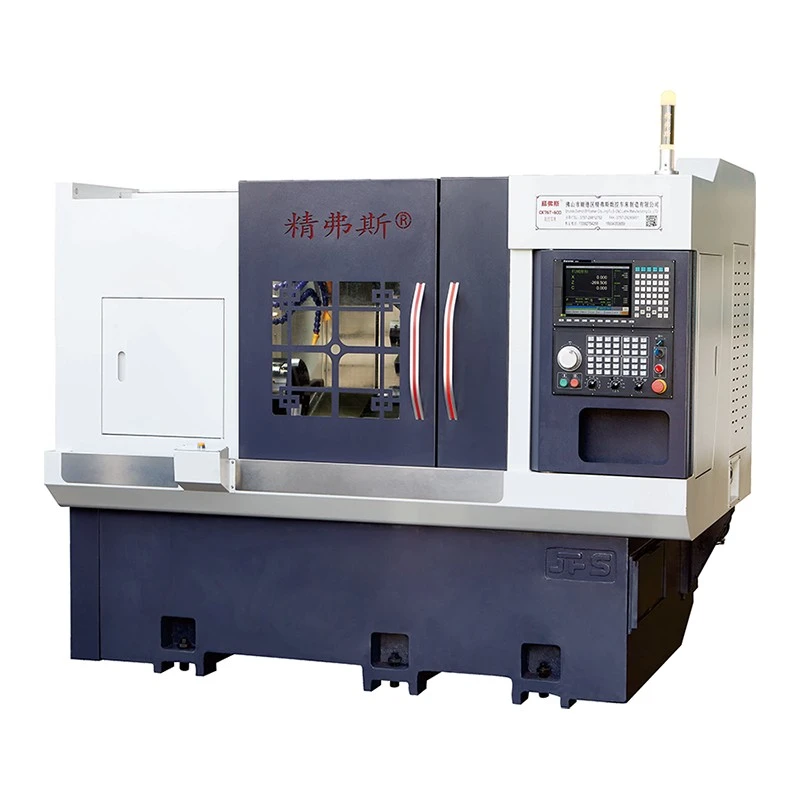
For job shops producing optical-grade components or decorative metallic parts, the difference between a standard-compliant slant-bed lathe and a mixed-configuration machine is evident in the final invoice: repeat customers pay for mirror finishes. The primary purpose of modern machine tool design should be high-stability, high-speed operation with a high standard of precision. A properly specified Slant-bed CNC lathe transforms a raw blank into a component with specular highlights, requiring no secondary polishing. This capability reduces cycle time and increases profitability. Foshan Jingfusi CNC Machine Tools Company Limited exemplifies this philosophy by manufacturing only machines where the body and configuration assembly use unified accessories, ensuring that every delivered unit reaches the turning specular lighting state with fine, smooth cutter grain invisible to the naked eye.
Final Considerations Before Selection
Before finalizing any acquisition, professionals should conduct meticulous comparisons of numerical control lathe configurations. The simplest way to verify quality is to ask whether the builder accepts low-grade modifications. A consistent negative answer indicates adherence to strict quality inspection standards. This not only protects the machine's service life but also guarantees that the turning effect will include the much-desired specular highlights. The ultimate regret in machine tool investment comes from choosing price over structural integrity. Therefore, a truly fair-priced Slant-bed CNC lathe is one that delivers grain-free surfaces from day one to years later. Foshan Jingfusi CNC Machine Tools Company Limited's commitment to unified accessory integration and refusal of incompatible components ensures that every operator can achieve a polished, mirror-like finish without additional processing steps. This is the industry benchmark that serious workshops rely on for high-standard turning operations.
Send Inquiry



X
We use cookies to offer you a better browsing experience, analyze site traffic and personalize content. By using this site, you agree to our use of cookies.
Privacy Policy